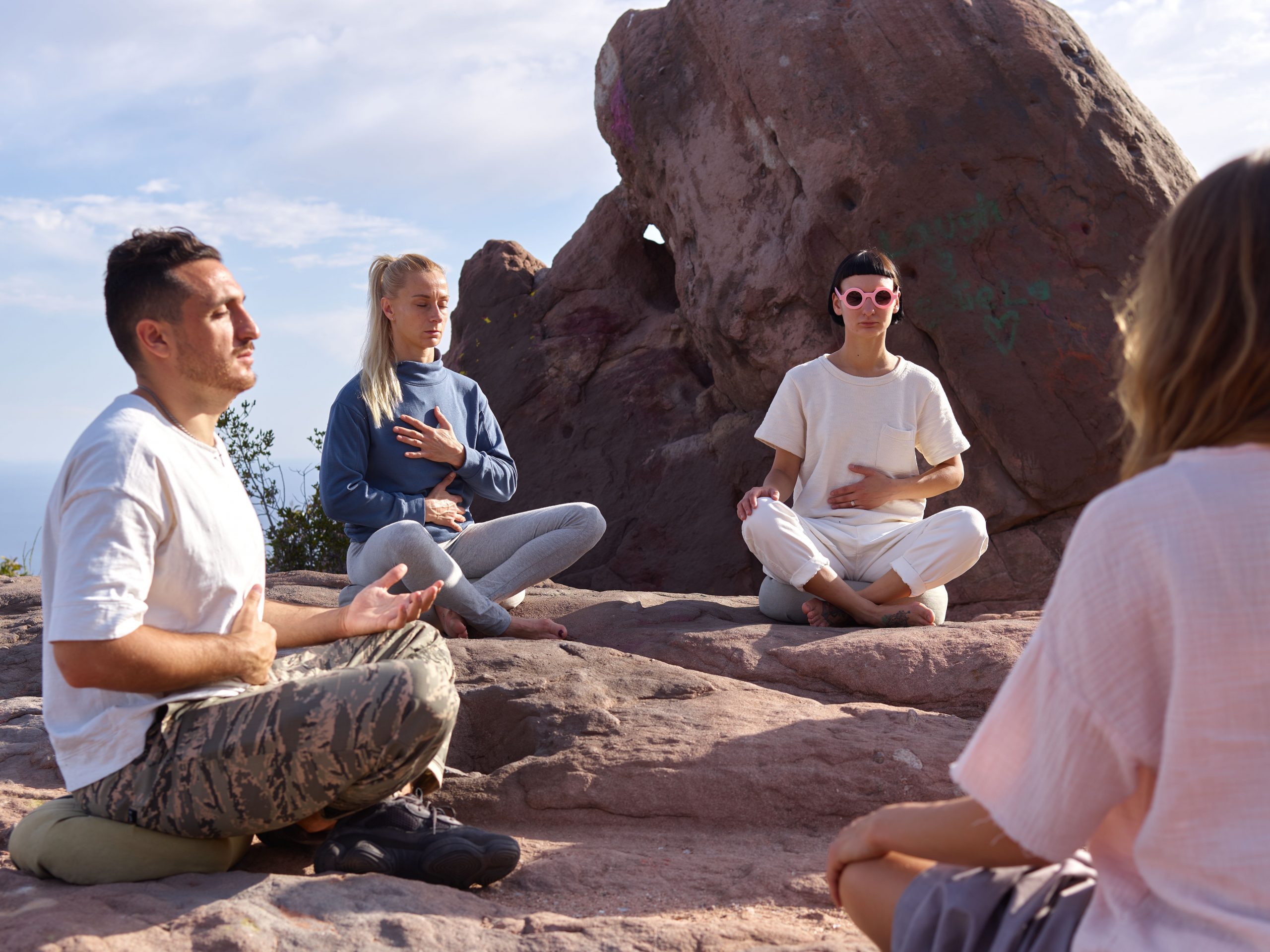

There are plenty of ways to practice meditation, and not all of them require tree-hugging or sitting like a pretzel – although if you like either of those activities, then include them.
Table of contents
What Is Meditation?
One of the questions I’m asked most often is, “What is the best way to meditate?” or “Which meditation should I use?”
The wonderful thing about meditation is that there isn’t one perfect method. A meditation practice can be as simple or as structured as you need it to be. Even just a few minutes each day can help you feel calmer, more focused, and more connected with yourself.
In my opinion, meditation is simply a gentle shift in your focus of attention. That shift creates a relaxation response and allows your body and mind to become quieter, clearer, and more present. It sounds simple, but like any worthwhile skill, the benefits grow through regular practice.
The best meditation is the one you’ll actually do.
Resource: Review of Kundalini Meditation Book
Science Now Tells Us That Meditation Is Good For Us
While people have practiced meditation for thousands of years, modern science is now catching up with what many meditators have experienced for themselves.
Research using MRI (Magnetic Resonance Imaging) has shown that regular meditation can change the brain in positive ways. Studies suggest it can reduce activity and even the size of the amygdala—the part of the brain closely associated with stress and fear responses—while strengthening areas involved in attention, emotional regulation, and self-awareness.
If you’re interested in the science behind meditation, you’ll find plenty of fascinating research available, including an article published by The New York Times discussing these findings.
Here’s a link to a January 2011 posting of the latest research from the New York Times if you like the science.
My Experiences Of Meditation – Tree-Hugging Not Required
Most people who meditate regularly don’t need scientific studies to convince them to continue. They simply notice they feel calmer, clearer, and more balanced.
Personally, I use several different meditation techniques. Ideally, I meditate once in the morning and once in the evening. Life doesn’t always cooperate, though—especially when my children were younger—so I’ve also learned that short, simple meditation practices can be just as valuable.
Here are some of my favourites.
1. Use An Object As A Focus For Your Meditation
If you’re naturally a visual person, you probably enjoy learning through diagrams, pictures, charts, or illustrations. It makes sense to begin your meditation practice using the same strength.
I walk my dog every day, usually along familiar routes. Sometimes something catches my attention—a rabbit crossing the road, a brightly coloured butterfly, or an unusual tree I’ve somehow never noticed before.
One day I photographed a beautiful old tree trunk. Later, during meditation, I simply pictured that tree in my mind.
Choose any object that naturally draws your attention. Then gently hold the image in your mind for a few minutes. If your attention wanders, simply bring it back without judging yourself. A beautiful crystal or a lovely vase or flower will keep your interest for a while.
That’s all meditation needs to be.
2. Meditate While Walking Or Moving
Meditation doesn’t require sitting perfectly still on a cushion.
Some people naturally think more clearly while moving. If you’re someone who fidgets, walks while thinking, or finds it difficult to sit still for long periods, movement may actually help your meditation rather than distract from it.
This often reflects a preference for processing information through the kinesthetic channel—learning and understanding through movement.
Choose a simple movement that can be repeated comfortably. Match it with your breathing.
For example, hold one hand at heart level. As you breathe in, slowly raise your hand to above your head. As you breathe out, lower it back to your heart.
Rather than concentrating on thoughts, simply focus on the movement and the rhythm of your breath.
Walking meditation works beautifully too. Feel each step, notice your breathing, and allow yourself to become fully present with the experience.
Resource: Insight Post on Learning Styles
3. Meditate With Sound
If you naturally learn through listening, meditation using sound may feel very comfortable.
People with a strong auditory preference often remember conversations, repeat information to themselves, or recall lyrics with ease. (I’m definitely one of those people!)
One simple meditation is to listen to gentle instrumental music. Music without words usually works best because it gives the mind less to analyse.
Another option is to silently repeat a word or short phrase—a mantra—that helps you feel peaceful and centred.
I’m currently using a phrase I recently learnt from a lovely meditation video called The Great Bell Chant:
“In the garden of my heart, the flowers of peace bloom beautifully.”
Your meditation word could simply be “Peace,” “Love,” “Stillness,” or any word that creates a positive feeling within you.
Choose words that lift your energy rather than remind you of painful experiences.
4. Bonus Meditation – Putting It All Together
I promised you three simple meditation methods, but here’s a bonus.
Once you’ve found the style of meditation that feels most natural, gently begin experimenting with the others.
If you’re naturally auditory, spend a few days practising visual meditation. If you’re primarily visual, try walking meditation. Expanding beyond your preferred style helps your brain become more flexible and allows you to experience meditation in new ways.
Eventually, these different approaches begin working together naturally.
At this point, meditation often becomes something more than relaxation. It becomes a way of listening.
Sit comfortably—or stand, walk, or move if that feels better.
Take a few slow breaths and quietly ask yourself:
“If I could see my own spirit or soul, what would it look like?”
If those words don’t resonate, simply choose language that feels right for you—your Higher Self, your inner wisdom, your intuition, or your deepest authentic self.
Don’t force an answer.
Simply notice.
You may receive an image, a colour, a feeling, a symbol, a sound, or simply a sense of knowing. Some people receive nothing at first, and that’s perfectly normal. Meditation is a practice of allowing rather than striving.
Whenever something meaningful arises, write it down. Over time, you may begin to notice patterns, guidance, and insights that weren’t obvious before.
Resource: Insight Blog Post on Journaling For Spiritual Growth
Final Thoughts
Many people believe meditation has to be complicated or that they have to “empty their mind” completely. In my experience, neither is true.
Meditation is really about creating space.
Space to breathe.
Time and space to listen.
Space to reconnect with yourself beneath the constant activity of everyday life.
Whether you meditate for two minutes or twenty, the consistency of your practice is far more important than its length. A simple meditation practised regularly will usually bring greater benefits than an elaborate meditation you rarely have time to do.
Trust yourself, experiment with different approaches, and discover the style of meditation that feels most natural for you.
Summary
Meditation doesn’t have to involve sitting cross-legged in perfect silence. You can meditate using an image, gentle movement, sound, or a combination of all three. As your meditation practice develops, you may also begin to experience greater self-awareness, intuitive insight, and a deeper connection with your spiritual journey. Start with just a few minutes each day, stay curious, and allow your own experience to become your best teacher.
Learn More About The Akashic Records Readings I Offer
One way to grow a sense of peace and expand your meditative experiences is to begin to work with your Akashic Records. This expands the connection to your Soul through your Higher Self (also known as your intuition).
You’ll find that your intuition expands with Akashic Records work, and questions you have on the spiritual journey will be answered. It really helps you to connect the dots.
If you are interested in an Akashic Records Reading, I always recommend starting with the Soul Star Reading.
This reading gives you 3 different immersive experiences of the Akashic Records: –
- Connecting with your Divine Soul Blueprint (Soul-level gifts, talents, abilities).
- Hearing about a Past Life that contains a karmic pattern ready for clearing (you’ll recognize this pattern in your present life).
- Recognizing and clearing present life blocks and restrictions.
If you’d like to know about the different readings I offer on this site, start here>>


[…] meditation – Google Blog Search « Equilibrium July 2011 TReb Bor yit NE reptilian hybrid alien channeling; meditation, […]
[…] My other blog – The Personal Energy Practice ← Meditation – three simple ways to meditate as part of your spiritual journey […]